
Conversation Architecture®️ Diagnostic: Not Theory, a Practice.
How conversational design shape strategy, collaboration, and smarter outcomes.
We spend our lives talking. It’s so fundamental we take it for granted but it’s as natural as breathing, as spontaneous as laughter.
But here’s what we miss: the conversations that actually matter inside organisations, networks and systems; the ones where strategy gets set, ventures get designed, collaborations get built, decisions with real consequence get made, those aren’t spontaneous at all. They require something different, something designed and much more intentional.
Leadership. The art of negotiation. Strategic thinking. We talk about these as distinct skills with separate capabilities but they all depend on the same thing - they all depend on and start with conversations. When a board meeting produces the same circular debate for the third time, that’s not a leadership problem. When a sustainability strategy stays stuck in good intentions, that’s not a commitment problem. When a collaboration collapses despite everyone’s best efforts, that’s not a people problem. This is a conversation architecture problem.
This is why the Conversation Architecture® Diagnostic exists. To make visible the conditions shaping how conversations actually function inside a system. Where decisions stall, where disagreement gets managed away and where good intent fails to translate into tangible action and change. Instead of asking what people think or prefer, it looks at the underlying conditions that make certain conversations possible (and others impossible) regardless of who is in the room.
Practically, the diagnostic is a structured questionnaire and asks five questions for each of the eight Elementals, forty in total. It takes time, attention and a willingness to reflect honestly rather than answer quickly. There are no right responses, no optimisation, no benchmarking against others. What it mirrors back is the quality of attention and the care you bring to it and a deep analysis on what is really influencing your strategic decision making, whether you want it to or not.
What It Takes to Show Up
Ask yourself: what does it actually take to show up for a conversation where something genuine is at stake?
Not a status update. Not a performance. A real conversation - the kind where breakthrough becomes possible, where what you thought you knew might shift, where collective intelligence can actually emerge and where discomfort is embraced rather than shunned.
It starts with what you bring, the secret ingredient is humility.
Not the performative kind, but structural. The recognition that what you may interpret isn’t reality itself and that what you know may be incomplete and what you’re certain about may be wrong. There also may be the crazy possibility that you might be the most senior person in the room and still unsure about what’s needed. That the people you’re working with are sources of knowledge and context that you don’t have, not just recipients of your expertise.
Genuine humility from positions of power means designing against your own default dominance.
Creating conditions where being wrong, challenged, fundamentally changed becomes possible, not just in theory but in practice. This kind of humility creates space for trust to emerge; not as something you demand or assume, but as something built through repeated acts of showing up honestly, listening genuinely, being willing to be changed by what you learn.
The Eight Elementals
We’ve identified eight core forces that shape how people show up in conversation and navigate complexity together.
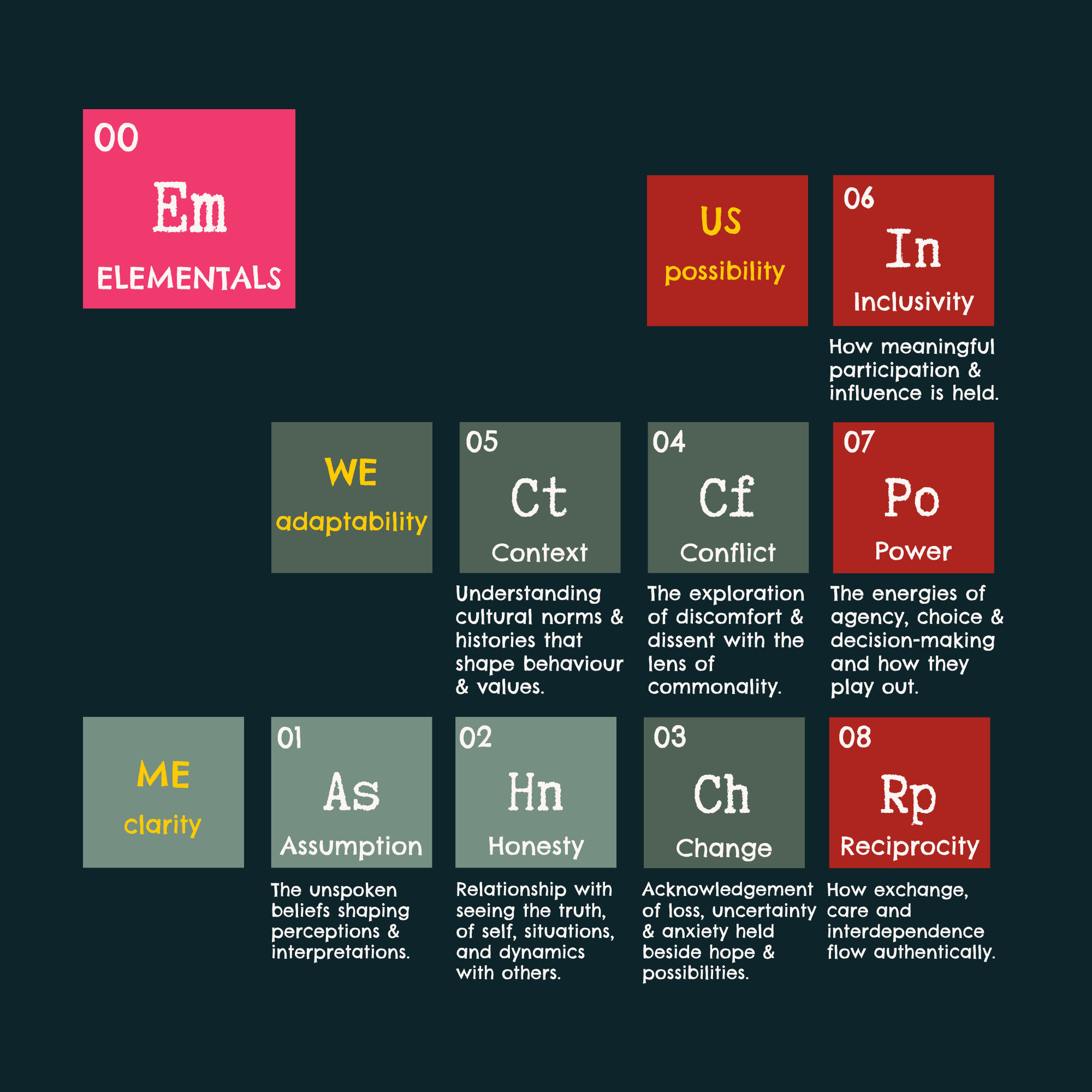
These aren’t separate capacities to develop in isolation. They work in relation to each other - how you navigate assumptions shapes your access to honesty, your capacity for conflict determines whether context can surface, your relationship with power affects how reciprocity flows. Together, they reveal the conditions people create when stakes are real: Can tension be held productively? Is there genuine intention for action? What becomes possible when these forces interact?
The diagnostic measures how these elementals are actually operating, not in theory, but in practice.
This is not a personality assessment or a leadership style inventory. It does not tell you who you are. It shows you how you tend to operate when stakes are real, and how those tendencies interact with others. The unit of analysis is not the individual in isolation, but the relational field they are part of. This is why the same person can appear highly capable in one context and constrained in another and why the diagnostic is a tool that you need to keep coming back to for different situations.
Why Context Matters for Conversational Capacity
Here’s what makes this exciting work: none of this is fixed.
The dynamics you hold aren’t static. They shift with context, with who’s in the room, with what’s at stake, with your own state. Your capacity with conflict in a one-to-one conversation is different from your capacity in a group where power is unevenly distributed. Which means one-size-fits-all approaches fail.
The conditions required for a board to make a difficult decision are different from conditions needed for a community to navigate contested change. The architecture that works for strategic planning doesn’t work for genuine co-creation with people who’ve been historically excluded.
This is why intentional design matters.
When conversations aren’t architected, they default to familiar patterns shaped by whomever has most structural power. Tension gets managed into process. Conflict gets absorbed into politeness. The hard questions get translated into safer ones.
Conversation Patterns: What Happens When Elements Collide?
From how these eight forces interact, twelve distinct patterns emerge. Not labels or personality types, but dynamics - coherent ways the elementals combine and sometimes contradict each other.
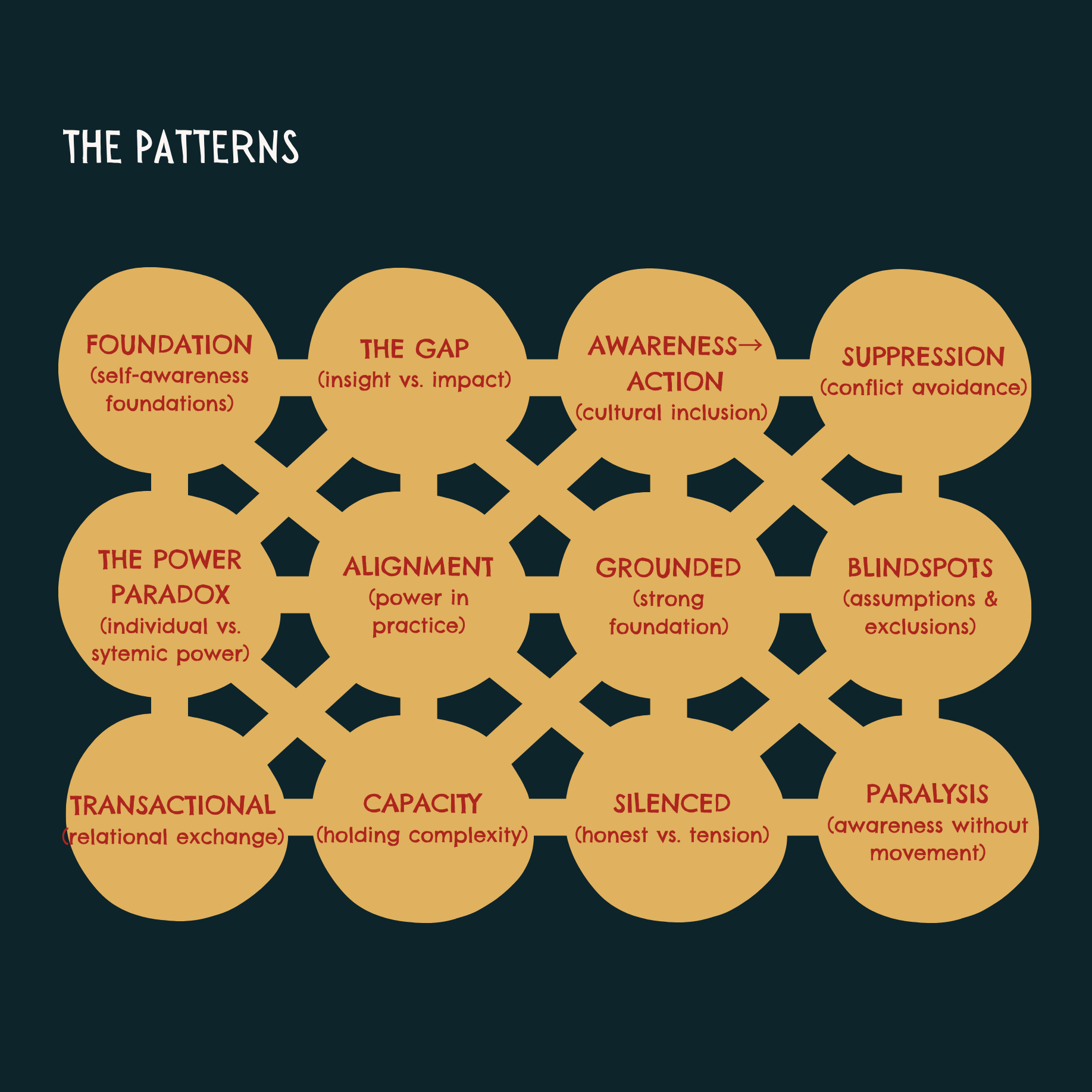
High awareness that doesn’t translate to action. Strong individual agency while collective power stays concentrated. Sophisticated analysis without relational grounding. The patterns reveal where capacity in one area fails to unlock another, where contradictions create tension, where gaps block breakthrough.
When groups complete the diagnostic together, collective dynamics become visible; Readiness dynamics - who’s equipped to hold what, Structural dynamics - how power and influence actually flow and the Constraints - what the system makes difficult regardless of individual capacity.
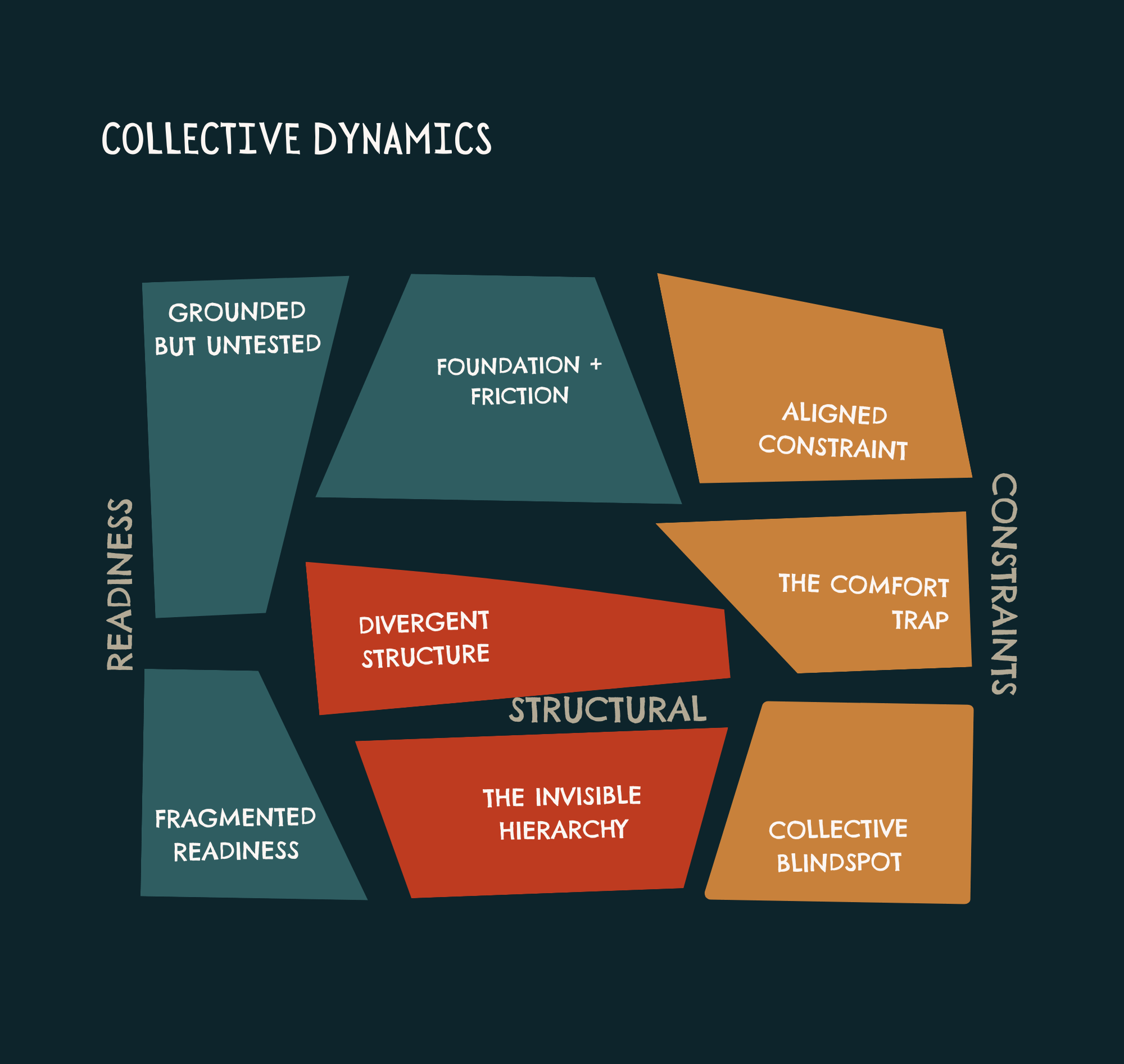
Groups are able to explore together and ask some fundamental questions like;“Why do our strategy sessions always end the same way?”, “Why does brilliant analysis never translate to implementation?”, “Why do we keep hiring for diversity but nothing actually changes?”. They can begin to see that their conversational conditions weren’t designed, they emerged by default and they’re reproducing exactly what they were structured to reproduce.
The diagnostic makes this visible. This isn't passive information, it's ammunition for intentional design. Once you see what's actually operating; the patterns, the gaps, the structural constraints - you can architect conversations that work with these dynamics rather than against them.
Why This Matters Now
We don’t have time to waste.
The challenges we’re facing; climate transformation, systemic inequality, geopolitical fragmentation, they require conversations we’ve never had, between people who’ve never sat together, about possibilities that don’t yet exist.
We can’t afford another strategy session that produces incremental adjustments to what already exists. Another stakeholder dialogue where the real tensions never surface. Another transformation initiative where nothing fundamental changes.
Better outcomes depend on better conversations. Better conversations depend on intentional architecture. Not spontaneity. Not hoping the right people in the room will figure it out. It needs the deliberate design of conditions where breakthrough becomes possible.
If any of this feels familiar; the stalled decisions, the conversations that circle without moving, the sense that insight never quite converts into action and if you’re wanting to be much more intentional in how you design for transformative systems change this year, the diagnostic gives you a way to see through. Not as blame, not as failure, but as architecture. Once understood, these patterns can be designed for rather than worked around.
The work begins with seeing what’s actually happening.
Take the diagnostic: https://bit.ly/ElementalDiagnostic